Like Your Fingers?
A journey from fast-food chaos to the Steelworker's contract.

Imagine for a moment that you are running a shift in a fast casual restaurant. You are rushing to go about your evening getting ready to close the store for the night. You wipe down the countertops and tables and arrange the napkin dispensers and salt and pepper shakers perfectly on each and every one. All while customers come and go. You just finished sweeping and mopping the dining room. Suddenly, your cashier runs from the back, chasing her boyfriend with ketchup and mustard squirt bottles. Next thing you know, you have a red and yellow mess all over the work you’ve spent hours completing. This happened to me about 26 years ago.
In the intervening years since, I’ve settled into running a press brake in a machine shop. I am now a member of the United Steelworkers and have certain protections that I didn’t have until fairly recently. For instance, I generally cannot be fired unless my company has layoffs, I fail to maintain good attendance, am grossly incompetent, or am insubordinate. Covering my work area in ketchup and mustard would surely qualify. Additionally, my raises are guaranteed in the contract. There is also no guesswork about what I’ll be making through the end of the contract, which is revised every five years. My healthcare is defined in the contract. My vacation time is defined in the contract.
I’m about 4 years into my job as a union steelworker. Before that, I worked for companies that weren’t just non-unionized; they actively discouraged union activity. This includes press brake roles but also driving across the country in an 18-wheeler, installing cable and internet residentially, foodservice, and retail across the states of Missouri, Kansas, and Colorado. In some cases I and my coworkers were explicitly told that unionizing would soil the worker/manager relationship. From my current vantage point as a union worker, that’s probably correct. But it’s a worthwhile trade. Allow me to explain with some examples from my work history.
My first job was in fast food. I grew up in Hazelwood, MO, about 5 miles from Ferguson in north St. Louis County. I was hired at 16 years old. I still remember the jacket I wore to my interview with Tracy. In fact, I remember the Shift Leader Byron handing me my application nonchalantly before I ever had an interview at all. For perspective, I am 44 today. The interview was short and easy and Tracy was very nice. It was more a casual conversation than an interview. She mostly asked me about school. I was hired and scheduled on the spot.
North county back then was in a state of flux. The Ford Plant was still just down the street and workers often stopped by on their lunch break on the weekdays. The lines were extremely long. The men looked dirty, sweaty, and hungry. They looked like their work was extremely demanding and I imagined they were compensated well for it. They were in a time crunch and they wanted to get back before the bell. Churchgoers would fill the dining room after church on Sundays. They came for the all you can eat Biscuits and Gravy and the atmosphere was generally upbeat and positive. This wouldn’t last as eventually both the Ford Plant and my Hardee’s would close their doors. Imagine the contrast, though. Union workers from a highly structured environment served by teenagers who were giving up their time off from school to pay explicitly for their weekends.
A few things stand out from my time at Hardee’s. Among them was horseplay. I remember on my first day a classmate of mine was working there, Casey. He was newly hired just as I was. Tracy took him to the biscuit area to show him how to make biscuits. After carefully using the cookie cutter tool to cut the biscuits from the rolled-out dough, Tracy slammed his hand down forcefully into a fully formed biscuit on the table, covering him in buttermilk and flour. That’s hazing. It’s not explicitly allowed but it was tolerated. This kind of behavior is expressly forbidden at my union job.
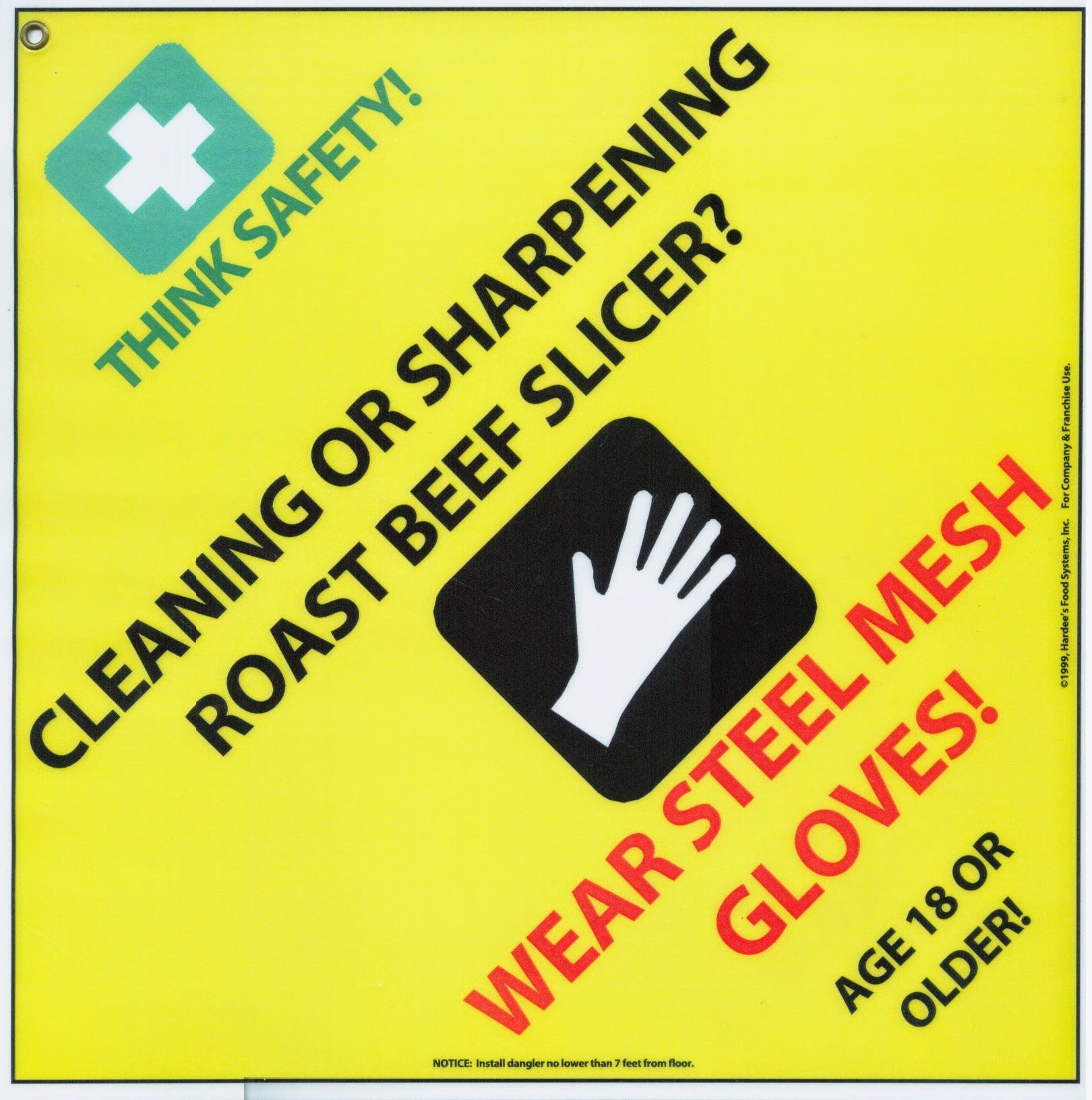
Work can be a dangerous place. In fast food, you are working with grills, fryers, char-broilers, very sharp knives, and very hot ovens. I distinctly remember the warning sign above our roast beef slicer. “Like your fingers?” In a metal shop, looking at the laser or welding torch can cost your vision. Holding a part too close to the pinch point of a press brake can cost you your fingers, as the function of a press brake is to crush a flat piece of steel at one seam until it bends to the desired angle. In a very real tragedy, a worker at my company running a lathe was hit with high-velocity material because a guard was absent. He died. These are environments where horseplay increases risk to life and limb.
Another thing that stands out is how employees were promoted. My promotion to Shift Leader happened well after the promotion of a much younger woman who worked with me there. I was incensed because I had worked there much longer. I wanted the extra money and status, too. Much later, after I was finally promoted to a Shift Leader, I was asked for input on the promotion of my brother over another employee. This was an uncomfortable conflict of interest. I couldn’t in good conscience choose my brother so I chose the other coworker. In a Union environment, there is strict separation between management and worker. Favoritism and nepotism seem much more acceptable among non-union employers. The worker culture is so strong in the union that promotion is often seen as a violation among equals. In fact, the application process to cross that line is entirely separate, which lends a stronger sense of fairness. You don’t have to second-guess why you didn’t get the promotion or why your brother didn’t choose you.
I have maintained a free-market worldview for a very long time, considering myself to be a libertarian. That’s still a great starting point for my political philosophy. Government is authoritarian and coercive and we must resist its tendency to overreach. However, throughout my working years I have discovered that human beings don’t always make great decisions. I’ve come to understand that unions have the capacity to impose order in an otherwise messy working life. They aren’t perfect by any means but there are many advantages that we sometimes neglect. Stability is just as necessary in workers’ lives as freedom is.