The Monetary Architecture of the Border Crisis
How decentralized money can end the cycle of displacement and state-sponsored surveillance.

The modern border is often viewed as a political or cultural battlefield, but it is the physical result of how our global money is designed. While we often discuss immigration in terms of laws and enforcement, it is more accurately described as a downward effect of monetary architecture. Because the United States dollar serves as the primary currency for the entire world, our financial decisions do not stay within our borders. When the supply of dollars expands, it reshapes global capital flows, inflates asset prices, and strengthens the relative position of dollar-denominated wealth. This process weakens local currencies and makes essential imported goods more expensive, disproportionately harming workers in developing nations whose savings and wages remain tied to fragile monetary systems.
Throughout history, the stability of money has quietly determined the stability of human settlement. Weak and unstable money tends to concentrate populations around centers of political and financial power, while hard and reliable money allows individuals to remain rooted where they are. Migration is always driven by a combination of factors, including local violence and government corruption, but monetary instability acts as the invisible accelerant that magnifies every one of these problems. When a family in the Global South sees their local currency collapse while the cost of basic goods rises, their ability to remain in their community disappears. They are essentially pulled toward the monetary center by the gravity of the dollar. In this light, the enforcement apparatus we see today, including raids and deportations, is a reactive attempt to manage a crisis that began with financial displacement.
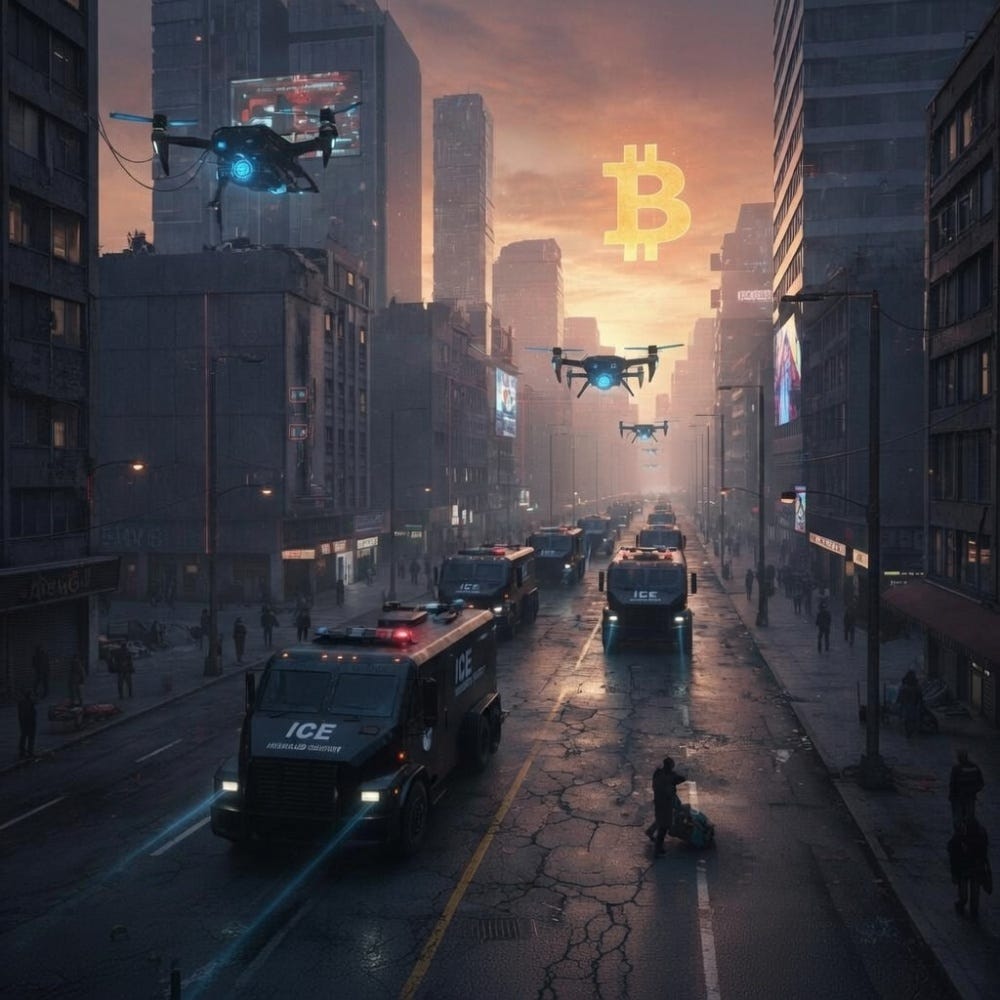
Current enforcement efforts do not rely only on physical walls, but on a massive layer of financial surveillance. The traditional banking system acts as a control surface that allows the state to track, monitor, and selectively target populations. Every time a person uses a bank account or a traditional wire service, they become visible to a government that can use that data for targeting. This financial visibility is what makes authoritarian raids possible. If the state controls the flow of money, it possesses the ultimate tool for tracking every move a person makes, turning the simple act of earning a living into a permanent record for law enforcement.
The transition to decentralized money represents more than a technological innovation; it represents a shift in the underlying architecture of human settlement. Bitcoin introduces a fundamental shift in this power dynamic by serving as a digital sanctuary that allows individuals to store the value of their labor independent of geography or state control. More importantly, it allows people in developing nations to save and build wealth even when their local currencies are destabilized by external monetary forces. Hard, neutral money reverses the dynamic that forces populations to move toward imperial centers. By separating economic survival from centralized financial infrastructure, decentralized money reduces both the pressure that drives migration and the surveillance mechanisms used to control it. For the first time in history, individuals can hold a form of money that is not tied to the political stability of the place where they were born. In doing so, it makes possible a world where economic stability no longer requires geographic displacement, and where individuals can remain rooted in their communities without sacrificing their sovereignty
.